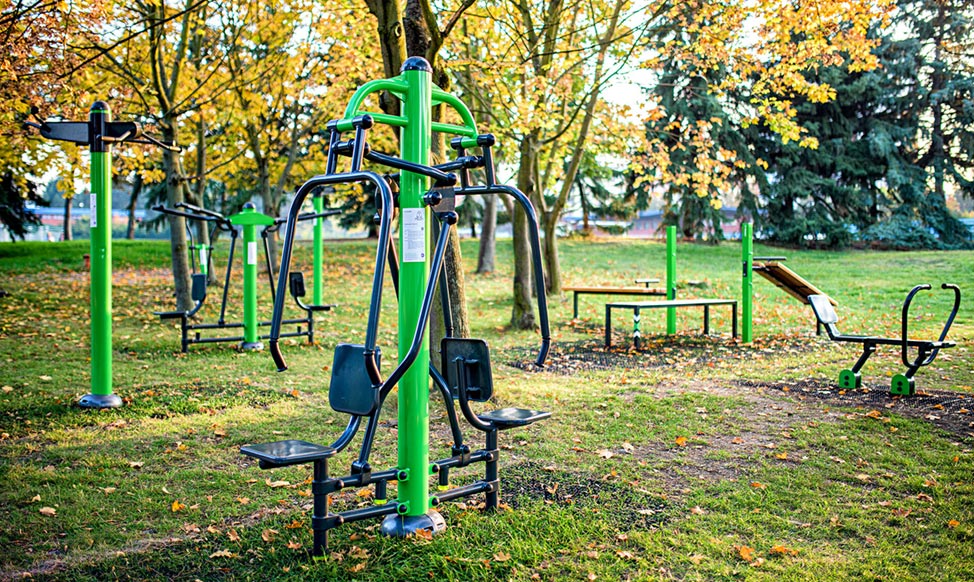
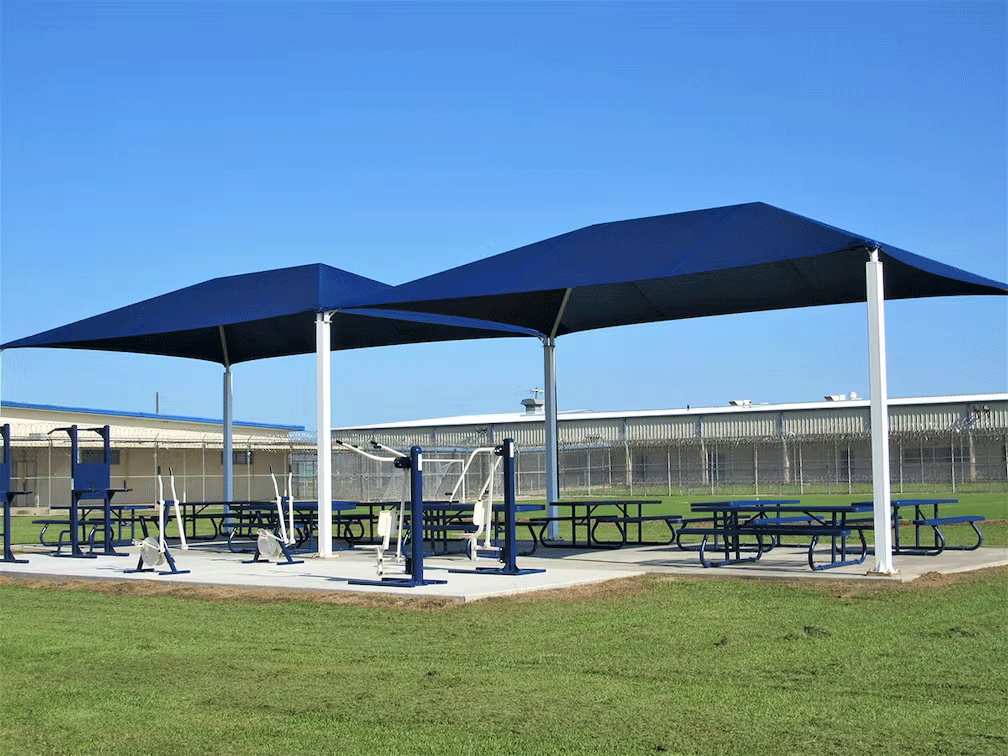
When an outdoor fitness area lacks ADA compliant outdoor fitness equipment, it isn’t just an oversight, it’s a legal violation. Under the ADA Standards for Accessible Design, both public parks and private senior facilities are required to provide accessible exercise equipment.
Non-compliance carries DOJ civil penalties up to $110,000 per violation, potential loss of federal funding, and exposure to private lawsuits where attorney’s fees are fully recoverable.
The compliance landscape for outdoor fitness, however, is less documented than for indoor facilities. Most available guidance addresses indoor commercial gyms or misses the outdoor-specific standards entirely, ground surface requirements, accessible route specifications, and weather-rated equipment design.
This guide covers all of it: the legal framework, exact measurements, what makes a wheelchair accessible outdoor gym actually compliant, and a 39-item checklist you can use for annual audits and vendor evaluation.
ADA Requirements for Outdoor Fitness Equipment
The two sections of the ADA Standards for Accessible Design that govern exercise equipment are Section 236 (scoping) and Section 1004 (technical requirements).
Section 236 establishes the minimum number of accessible pieces required: at least one of each type of exercise machine must comply. The key word is “type.” Upper body, lower body, cardio, flexibility, and balance are each considered separate types under the standard. One accessible piece per type is the minimum, not one accessible piece per facility.
Section 1004 defines the technical requirements: clear floor space dimensions, transfer seat specifications, and reach range limits that each compliant piece must meet.
The legal authority under which compliance is required depends on who operates the facility:
| Framework | Applies To | Enforcement |
| Title II | State and local government facilities, public parks, municipal recreation areas | DOJ investigates complaints; can require remediation or pursue civil penalties |
| Title III | Public accommodations, private senior living communities, HOA-managed facilities open to residents | DOJ can file lawsuits; individuals can sue directly |
| Section 504 | Any facility receiving federal funding, including CDBG grants or federal recreation funds | HHS and relevant federal agencies; non-compliance can trigger funding loss |
Both Title II and Title III require compliance. The enforcement pathway differs, but neither is optional.
Clearance and Spacing Specifications
Equipment selection is only half the compliance equation. Layout and clearance determine whether a wheelchair user can actually reach and use the equipment once installed. The following specifications apply to every accessible piece in an outdoor fitness area.
| Specification | Requirement | ADA Reference |
| Clear floor space | 30″ x 48″ minimum | Section 305 |
| Turning space | 60″ diameter (circular) or T-shaped | Section 304 |
| Accessible route width | 36″ minimum | Section 403 |
| Maximum route slope | 1:12 (8.33%) | Section 405 |
| Forward reach (low) | 15″ minimum | Section 308 |
| Forward reach (high) | 48″ maximum | Section 308 |
| Transfer seat height | 14–24″ compliant (17–19″ ideal) | Section 1004 |
| Transfer platform width | 25–27″ minimum | Section 1004 |
Accessible route requirements are frequently the point where otherwise compliant installations fail. The accessible route must connect every accessible piece of equipment to the facility’s parking area, entrance, and other amenities, not just connect accessible pieces to each other. A 36″ minimum width must be maintained throughout, with no running slope exceeding 1:12 and no cross slope exceeding 1:48.
Reach ranges govern controls, handles, and any interactive elements on equipment. At 15″ minimum and 48″ maximum for forward reach, these limits are designed for a wheelchair user approaching from the front. Side-approach reach limits apply the same ceiling but allow for slightly different positioning, the US Access Board’s technical guidance covers both approach types in detail.
Ground surface requirements interact directly with clearance specs. A compliant 30″ x 48″ clear floor space is only compliant if the surface beneath it meets ASTM standards, covered in the next section.
What Makes Fitness Equipment Wheelchair Accessible?
Not all accessible outdoor exercise equipment is designed the same way. Before purchasing from any manufacturer, understand which of the three accessibility categories each piece falls into, the category determines what your installation requires and who can use the equipment.
1. Wheelchair-Stationed Equipment
The user exercises directly from their wheelchair, no transfer required. This is the highest level of accessibility. Examples include arm cycle machines and accessible press/pull stations designed with open side entries and clear floor space that accommodates the wheelchair itself.
When reviewing equipment from any vendor, ask specifically: Does the user ever need to leave their wheelchair to use this piece? If the answer is yes, it is not wheelchair-stationed equipment.
2. Transfer Equipment
The user transfers from their wheelchair to a seat, bench, or platform on the equipment. Transfer equipment is ADA-compliant when the transfer surface meets the height requirement (17–19″ is ideal within the 14–24″ compliant range) and the platform width (25–27″ minimum).
Transfer design must also consider the approach direction and the presence of grab bars to facilitate the transfer safely.
3. Dual-Use Equipment
Equipment engineered for simultaneous or interchangeable use by both wheelchair users and ambulatory users. True dual-use design serves the full range of users without requiring separate equipment for each group.
Beyond category classification, look for these design features:
- Grip design: Larger diameter, textured handles accommodate users with limited grip strength or reduced hand/arm function. Thin, smooth handles exclude a meaningful portion of the population with disabilities.
- No cables or hydraulics: Outdoor environments introduce UV exposure, precipitation, and temperature extremes that degrade cable-based and hydraulic resistance systems. Mechanism failure creates both safety hazards and maintenance burdens. Bodyweight and gravity resistance systems eliminate these failure points.
- Color contrast: High-contrast handles and contact points (against the equipment frame) support users with visual impairments in identifying grip points and movement ranges.
- Pictogram signage: Instructional signs that rely on text-only instructions exclude users with cognitive disabilities and non-English speakers. Pictogram-based instructions with clear action sequences serve all users.
A vendor who can clearly explain which category each piece falls into, and back it up with documented specifications, is a vendor worth taking seriously.
Ground Surface Requirements
Ground surface is the most commonly overlooked element of outdoor fitness ADA compliance, and one of the most commonly cited reasons installations fail audits. The surface requirements are not guidelines, they are written into ADA law.
ASTM F1951 is the standard specification for wheelchair accessibility of surface systems. It tests whether a person in a wheelchair can maneuver across a surface, specifically measuring the work required to propel a wheelchair forward and turn on the material. A surface can look flat and firm and still fail F1951 testing. Under ADA, accessible outdoor fitness areas must use surfaces that meet this standard.
ASTM F1292 is the standard specification for impact attenuation. It addresses fall protection within the use zone of equipment. Both standards apply simultaneously, a surface must be both accessible for wheelchair travel and safe for impact events.
Materials that comply:
- Poured-in-place rubber: The most common choice for ADA-compliant outdoor fitness installations. Provides consistent F1951 performance and is durable in outdoor environments. Requires periodic inspection for cracking and separation at seams.
- Interlocking rubber tiles: Compliant when properly installed and maintained. Tiles can shift or separate over time, creating trip hazards and ADA violations. Fastening systems and installation quality determine long-term performance.
- Engineered Wood Fiber (EWF): Compliant when properly installed to the correct depth and regularly maintained. EWF compacts over time, which degrades both impact attenuation and wheelchair accessibility. Facilities using EWF need a documented maintenance schedule with regular depth checks and top-up protocols.
Materials that do not comply: Loose gravel, sand, grass, standard wood chip mulch.
Maintenance is not optional. All compliant surfaces degrade. Poured rubber cracks. Tiles shift. EWF compacts. A surface that was compliant at installation can fall out of compliance within months without a maintenance schedule. Facilities need a documented inspection program, not just a compliant surface at installation.
ADA Compliance Checklist for Outdoor Fitness Areas
Use this checklist for annual compliance audits, new installation planning, or evaluating equipment vendors during procurement. Each item maps to a specific ADA or ASTM requirement. This is not a best-practice list, it is a legal compliance baseline.
✅ Accessible Routes
- Route connects parking/entrance to all accessible equipment
- Route width is 36″ minimum throughout
- Running slope does not exceed 1:12 (8.33%)
- Cross slope does not exceed 1:48 (2.08%)
- Route surface is firm, stable, and slip-resistant
- No abrupt level changes greater than 1/4″
✅ Ground Surfaces
- Surface complies with ASTM F1951 (wheelchair accessibility)
- Surface complies with ASTM F1292 (impact attenuation)
- Surface material is poured rubber, rubber tiles, or compliant EWF
- Surface extends through full use zone of each accessible piece
- Maintenance schedule documented for surface inspection and repair
✅ Clear Floor Space
- 30″ x 48″ minimum clear space at each accessible piece
- 60″ turning space available at each accessible station
- Clear space is level (max 1:48 slope in any direction)
- Clear space connects to accessible route without obstruction
✅ Equipment Design
- At least one of each equipment TYPE is accessible
- Wheelchair-stationed equipment requires no transfer
- Transfer surfaces are 17–19″ height where applicable
- Transfer platforms are 25–27″ wide minimum where applicable
- Grips accommodate limited hand/arm strength
- No cables, hydraulics, or mechanisms requiring fine motor control
- Color contrast on handles and contact points
- Moving parts cannot entrap fingers, limbs, or clothing
- Equipment rated for outdoor use (UV, weather, corrosion resistance)
✅ Signage
- International Symbol of Accessibility posted at accessible stations
- Instructional signage includes pictograms (not text-only)
- Signage mounted within accessible reach range (15–48″)
- Signage has high contrast and minimum 5/8″ character height
✅ Supporting Amenities
- Accessible bench/rest area within the fitness zone
- Accessible drinking fountain or water station nearby
- Accessible restroom within reasonable distance
- Accessible shade structure (if shade is provided for non-accessible areas)
- Accessible path to all supporting amenities
✅ Documentation & Maintenance
- ADA compliance documentation on file for all accessible equipment
- Surface inspection schedule established (minimum quarterly)
- Equipment inspection schedule established (minimum monthly)
- Repair/replacement protocol documented
- Staff trained on ADA requirements for the fitness area
- Complaint/feedback process in place for accessibility issues
A vendor who can address every category on this checklist, from equipment design through installation and surface requirements, reduces your compliance risk and simplifies procurement.
Enforcement and Penalties
The Department of Justice is the primary enforcement agency for ADA compliance. Understanding the penalty structure and enforcement mechanisms helps communicate urgency to decision-makers and budget committees who may view accessibility upgrades as discretionary.
For public facilities (Title II): DOJ investigates complaints filed against state and local government agencies. Investigations can result in mandatory remediation, consent decrees, and civil monetary penalties.
For private facilities (Title III): DOJ can initiate enforcement actions against public accommodations that fail to comply. Individuals can also file private lawsuits without DOJ involvement, and because ADA lawsuits allow for recovery of attorney’s fees, litigation is financially accessible for plaintiffs, which increases the volume of private suits filed each year.
Civil penalties:
- First offense: up to $55,000
- Subsequent violations: up to $110,000
Federal funding: Any facility receiving federal funding, including Community Development Block Grants, Land and Water Conservation Fund allocations, or other federal recreation funding, faces Section 504 compliance obligations. Non-compliance can result in suspension or termination of that funding.
State codes: Some states impose requirements that exceed federal ADA minimums. California Title 24 and the Texas Accessibility Standards (TAS) are two examples. Facility managers should verify local requirements in addition to federal standards, ADA compliance is a floor, not a ceiling.
How TriActive USA Supports ADA Compliance
After reviewing the checklist above, the practical question becomes: which equipment satisfies the compliance requirements without creating a maintenance burden over time? TriActive USA’s accessible outdoor fitness line is engineered specifically for the compliance profile outlined in this guide.
The Accessible Multi-Gym (MGYM) is a 4-user station where every position accommodates wheelchair use. No transfer is required, users exercise directly from their wheelchair, eliminating the transfer surface compliance questions that arise with bench-based equipment. Multiple exercise types are available at a single station, which helps facilities address the “one per type” requirement efficiently.
The Tai Chi Spinners (TCHI) use a dual-sided design: one side engineered for ambulatory users, the opposite side for wheelchair users. This true dual-use approach means the equipment serves the full range of park visitors without requiring separate accessible and non-accessible stations.
The Wheelchair Accessible Combo Press & Pull provides upper body exercise with wheelchair-stationed access. No cables, no hydraulic resistance, gravity and bodyweight resistance only, which eliminates the mechanical failure risks that cable-based systems present in outdoor environments.
Design specifications that check the compliance boxes:
- Bodyweight and gravity resistance: no cables or hydraulics (addresses equipment design checklist items 6 and 8)
- 11-gauge welded steel construction: no sharp edges, no removable parts, no entrapment hazards
- UV, weather, and corrosion-rated for outdoor installation
- 100% Made in USA (Southern California), domestic manufacturing with direct warranty support
TriActive also provides layout design consultation through installation. If you’re planning a new outdoor fitness area or retrofitting an existing one, their team can help develop an ADA-compliant layout before any equipment is ordered, not just after delivery.
Frequently Asked Questions
Does ADA apply to outdoor fitness equipment?
Yes. Under Section 236 of the ADA Standards for Accessible Design, at least one of each type of exercise machine must be accessible. This applies to both public parks under Title II and private facilities open to the public under Title III. Outdoor location does not exempt a fitness installation from ADA requirements.
How many accessible pieces of outdoor fitness equipment do I need?
At least one per type. Types are defined by function, upper body, lower body, cardio, flexibility, and balance are each considered separate types. One accessible piece per type is the minimum. A five-station fitness circuit with one accessible piece total is not compliant if that single piece only addresses one exercise type.
What ground surface is required under accessible outdoor fitness equipment?
The surface must comply with ASTM F1951 (wheelchair accessibility) and ASTM F1292 (impact attenuation). Acceptable materials include poured-in-place rubber, interlocking rubber tiles, and properly maintained Engineered Wood Fiber. Grass, gravel, sand, and standard wood chip mulch do not comply.
What is ASTM F1951?
ASTM F1951 is the Standard Specification for Determination of Accessibility of Surface Systems Under and Around Playground Equipment. It tests whether a wheelchair user can maneuver across a surface by measuring the work required for propulsion and turning. This standard is incorporated into ADA law, compliance is required, not recommended.
Can a person in a wheelchair use outdoor fitness equipment?
Yes, when equipment is designed for it. Wheelchair-stationed equipment allows users to exercise directly from their wheelchair with no transfer required. Equipment like the TriActive Accessible Multi-Gym is designed for exactly this use. Properly designed transfer equipment also provides access for wheelchair users who are able to transfer.
What are the penalties for non-compliant outdoor fitness areas?
DOJ civil penalties reach $55,000 for a first offense and $110,000 for subsequent violations. Facilities receiving federal funding risk suspension or loss of that funding under Section 504. Individuals can also file private ADA lawsuits directly, no DOJ involvement required, and attorney’s fees are recoverable, which makes litigation financially accessible for plaintiffs.
Conclusion
ADA compliance for outdoor fitness areas is a legal requirement, not a feature, not a differentiator, a baseline. The specifications in this guide and the checklist above represent the minimum threshold every public park and private senior facility must meet.
The checklist here isn’t a one-time read. Use it for your next annual audit, your next capital project, and your next vendor evaluation. Every item maps to an enforceable standard.
At TriActive USA, the position is straightforward: everyone should have access to exercise. Their accessible outdoor fitness equipment is built to make that position operationally real, compliant by design, durable by construction, and supported from layout planning through installation.
Ready to plan a compliant outdoor fitness area? Request a Quote from TriActive USA.