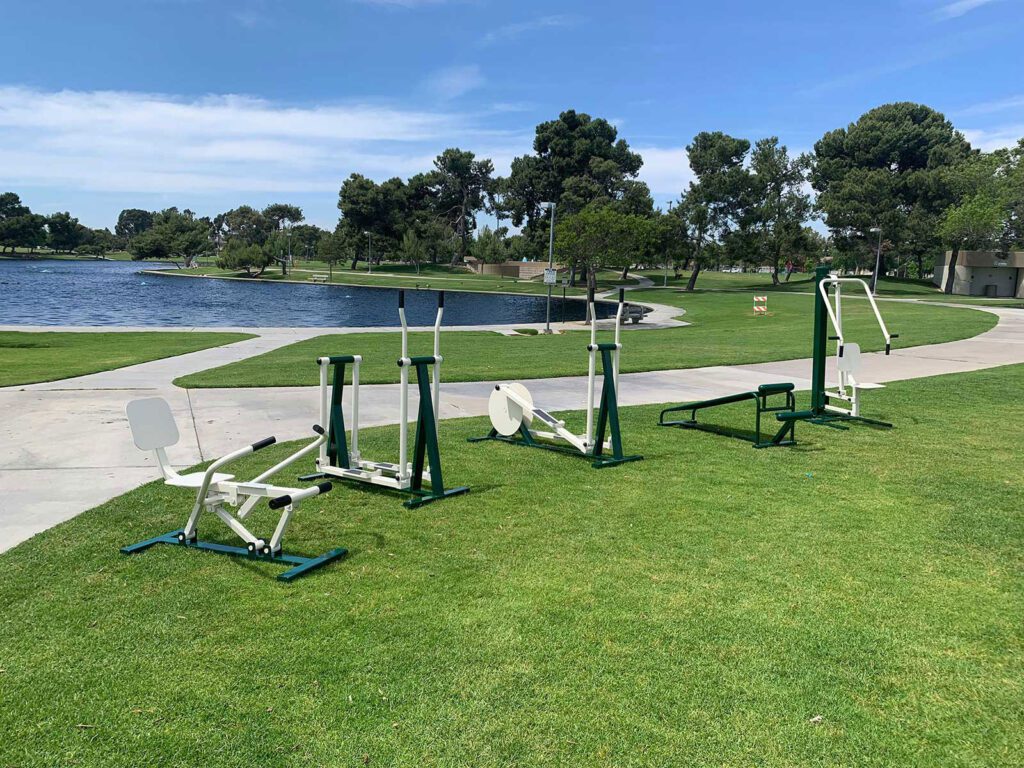
A parks director in a coastal city requests three quotes for a new outdoor fitness installation. The bids come back at $4,800, $14,200, and $32,500. All three sellers call their products “outdoor fitness equipment.” One bid is residential grade sold through a big-box retailer. Two are commercial outdoor fitness equipment built for institutional use. By year three, the cheapest option is in a dumpster and the parks department is drafting an emergency purchase order.
The difference between residential and commercial outdoor fitness equipment is not a marketing label. It is a measurable gap in steel gauge, weld construction, finish thickness, warranty length, compliance testing, and weight capacity. That gap determines whether the equipment is still standing at year 10 or replaced twice before then.
This guide draws the line across the four decisions that matter most to institutional buyers: durability, warranty, compliance, and total cost of ownership. If you are specifying equipment for a park, school, HOA, military base, correctional facility, or senior living community, read this before you sign the purchase order.
The Grade Gap: What “Commercial” Actually Means
Residential outdoor fitness equipment is engineered for one user, a few sessions per week, in a protected backyard. Commercial outdoor fitness equipment is engineered for dozens of unsupervised users per day across weather, vandalism, and high-load conditions. The specifications that separate the two tiers are not subtle.
| Specification | Residential Grade | Commercial / Institutional Grade | TriActive USA |
| Steel gauge | 14 to 16 gauge (0.06 to 0.08 inch) | 11 gauge welded schedule 40 tube (0.12 inch+) | 11 gauge welded schedule 40 |
| Assembly | Bolted | Welded | Welded, tamper-resistant hardware |
| Finish | Single-layer powder coat | Zinc primer + 6 to 8 mil powder coat | Zinc primer + 6 to 8 mil powder coat |
| Salt spray testing | Not tested | 1,000+ hours (ASTM B117) | 1,000 hours |
| Weight capacity | 250 to 300 lb | 350 lb per user | 350 lb |
| Structural warranty | 1 to 3 years limited | 5 to 25 years | 10 years structural |
| ASTM F3101 design | Not designed to | Designed to or tested against | Designed to institutional spec |
| Country of origin | Typically imported | Varies | 100% Made in USA |
An 11 gauge steel wall is roughly twice as thick as 16 gauge. Under cyclic load, that thickness doubles impact resistance and roughly quadruples fatigue life. Welded assemblies cannot be unbolted, stolen for parts, or pocketed as weapons in secure environments.
A zinc primer under the powder coat protects the substrate even when the top layer chips. These are not upgrades. They are the baseline for equipment that survives institutional use.
The governing standard is ASTM F3101-21a, the ASTM International specification for stationary outdoor adult fitness equipment. Commercial manufacturers design to or test against F3101. Residential manufacturers do not. For a deeper walkthrough of the standard, see our ASTM F3101 compliance guide.
Durability: Why Residential Equipment Fails in Institutional Settings
Residential outdoor fitness equipment is rated for maybe 15 user-sessions per week. Put the same unit in a city park and it sees 50 or more users per day. That is over 23 times the annual cycle count the equipment was designed for. The failure modes are predictable and they are documented in CPSC NEISS injury data.
Cracked welds and stripped hardware. Bolted assemblies loosen over thousands of cycles. Once a bolt starts to work free, the joint flexes, fatigue-cracks the tube at the connection, and fails under load. Residential frames are not rated for the cycle count.
Corrosion from the inside out. Without a zinc primer, moisture penetrates powder coat chips within 2 to 3 winters, rusts the steel substrate, and blisters the finish. Closed tube sections with unsealed welds rust from the inside where no one sees it until the tube fails.
Stolen and weaponized hardware. Bolted construction lets users remove parts. In a park that looks like vandalism. In a correctional facility it is a security incident. Commercial specifications eliminate removable parts entirely through welded assembly and tamper-resistant rounded-head stainless steel fasteners.
Finish failure in harsh climates. Coastal salt air, high-UV desert exposure, and freeze-thaw cycles each degrade unprotected powder coat differently. Commercial equipment is tested to 1,000 hours of ASTM B117 salt spray resistance. Residential equipment is rarely tested at all.
TriActive USA builds every unit with 11 gauge welded schedule 40 tube, a zinc primer plus 6 to 8 mil powder coat finish, and rounded-head stainless steel tamper-resistant hardware. That construction backs the 10 year structural warranty and the “Hundreds of Installations Nationwide” trust signal.
Warranty: The Single Clearest Signal of Grade
If you only have time to compare one specification, compare the structural warranty. Warranty length is the most honest signal a manufacturer can give, because warranties are underwritten against actuarial failure data. A 1 year warranty means the manufacturer expects trouble in year 2. A 10 year structural warranty means the manufacturer has installation data proving the frame lasts a decade.
| Component | Residential | Entry Commercial | Mid-Premium Commercial | Ultra-Premium |
| Structural steel | 1 to 3 years | 5 years | 10 years (TriActive) | 25 years |
| Welds and joints | Often excluded | Covered | Covered | Covered |
| Moving parts | 90 days to 1 year | 1 to 2 years | 5 years (TriActive) | 5 to 10 years |
| Rubber and hardware | Not covered | 1 year | 2 years (TriActive) | 2 to 5 years |
| Finish / powder coat | Not covered | 1 year | Varies | Up to 5 years |
Read the fine print. A “lifetime frame warranty” on a residential product almost always excludes welds, joints, coating, and hardware, which are the exact components that fail first. Institutional contracts frequently require a minimum 5 or 10 year structural warranty to qualify a vendor at all. Many federal and municipal procurement processes will disqualify a residential-grade bid before it gets to technical review.
Compliance: ASTM F3101, ADA, CPSC, and Buy American
Compliance is where residential outdoor fitness equipment most visibly falls short. Four standards matter for institutional installations, and not all of them apply to every buyer.
ASTM F3101-21a (Stationary Outdoor Adult Fitness Equipment). This ASTM International standard defines load requirements, finger and head entrapment tolerances, fall zone geometry, structural integrity testing, and labeling for adult fitness equipment installed in public spaces. Commercial-grade manufacturers either design to F3101 or test against it. Residential equipment is not evaluated under this standard. For parks, schools, and any unsupervised public installation, F3101 is the baseline technical reference.
ADA and ABA Accessibility Standards. The ADA 2010 Standards for Accessible Design require accessible routes to fitness equipment in public accommodations and federal facilities. Sections 305 and 308 define reach ranges and clear floor space. For senior living communities, municipal parks, HOA common areas, and any school facility, ADA-compliant outdoor fitness equipment is not optional. Commercial manufacturers offer accessible stations. Residential manufacturers do not.
CPSC guidance and NEISS data. The Consumer Product Safety Commission publishes outdoor safety guidance and tracks injury data through the National Electronic Injury Surveillance System. Adult fitness equipment installed in public spaces falls under a different liability regime than home backyard use. Municipalities and facility operators can be held liable for equipment-related injuries when specifications and installation do not meet recognized industry standards.
Buy American Act and the Trade Agreements Act. FAR Part 25 governs domestic content requirements for federal procurement. Military base installations, GSA Schedule purchases, and many federally-funded parks projects require equipment manufactured in the United States. Imported residential equipment does not qualify. TriActive USA is a GSA Schedule contractor with 100% domestic manufacturing in Southern California, which qualifies under Buy American Act and Trade Agreements Act requirements.
Compliance obligations vary by buyer segment:
| Buyer | F3101 | ADA | Buy American | Security Spec |
| Parks & Recreation | Required | Required | Often | Recommended |
| Schools | Required | Required | Sometimes | Recommended |
| HOAs | Recommended | Required (common areas) | Optional | Optional |
| Military Bases | Required | Required | Required | Recommended |
| Correctional Facilities | Required | N/A to users | Often | Required |
| Senior Living | Required | Required | Optional | Optional |
Total Cost of Ownership: The 10 Year Math
Purchase price is the smallest component of total cost of ownership over a 10 year horizon. The real costs are replacement cycles, repair labor, facility downtime, emergency procurement, and liability exposure. The math favors commercial outdoor fitness equipment by a wide margin for any institutional installation.
Consider a side-by-side comparison for a single pull-up and dip station installed at a municipal park:
| Line Item | Residential Grade | Commercial Grade (TriActive) |
| Initial purchase | $500 | $3,500 |
| Installation (footings, labor) | $400 | $600 |
| Year 2 replacement | $500 | $0 |
| Year 2 reinstallation | $400 | $0 |
| Year 4 replacement | $500 | $0 |
| Year 4 reinstallation | $400 | $0 |
| Year 6 replacement | $500 | $0 |
| Year 6 reinstallation | $400 | $0 |
| Year 8 replacement | $500 | $0 |
| Year 8 reinstallation | $400 | $0 |
| Rust remediation and repair | $600 | $0 |
| Downtime (days) | ~40 | ~0 |
| 10 year cost | $5,100 | $4,100 |
| Liability exposure | High (no F3101 testing) | Low (F3101 spec) |
That is a conservative example. The residential line does not account for staff time spent coordinating replacement procurement, user complaints, or the reputational cost of a public amenity that is visibly broken for weeks at a time.
A single injury claim from failed residential equipment in a public park can exceed the entire 10 year commercial purchase price. Front-loaded outdoor fitness project planning almost always pays for itself before year three.
The math gets more favorable for commercial grade in harsh climates, high-traffic installations, and facilities with strict compliance obligations. For HOAs, schools, parks, and senior living communities, specifying commercial outdoor fitness equipment on day one is the least expensive option over the equipment’s actual service life.
Spec’ing the Right Grade by Buyer Type
The right specification depends on the environment, not the brochure. Use this as a starting point and request written answers from every vendor you evaluate.
Parks & Recreation. Commercial grade, ASTM F3101 compliant, ADA-accessible stations included, powder coat rated for the local climate (salt spray for coastal, UV-stable finish for desert and high-altitude installations).
Schools. Commercial grade, ASTM F3101 compliant, age-appropriate reach ranges, no pinch points, tamper-resistant welded assembly suitable for unsupervised recess or PE use.
HOAs. Commercial grade only. Residential-branded equipment in a shared amenity is a liability mistake, because HOA common areas are legally closer to public accommodations than to private residences. ADA reach ranges apply. Prioritize compact footprints and quiet operation.
Military Bases. Commercial grade, Buy American Act compliant, GSA Schedule procurement preferred, 350 lb per-user capacity for high-volume rotational use. See our GSA and cooperative procurement options for federal and military buyers.
Correctional Facilities. Commercial grade with security-specific features: welded assembly with no removable parts, rounded-head tamper-resistant hardware, bodyweight and gravity resistance only (no cables, pulleys, or free weights). TriActive USA is the #1 correctional fitness equipment manufacturer in the United States with hundreds of installations nationwide.
Senior Living Communities. Commercial grade with ADA-compliant wheelchair-accessible stations, low-impact exercise options, fall zone compliance, and handrail integration for stability. Safety and accessibility take priority over load capacity.
Whichever segment you serve, the pattern is the same: commercial outdoor fitness equipment is the floor, not the ceiling. Residential equipment rarely fits an institutional use case at all.
How to Verify a Vendor Is Actually Commercial Grade
Marketing language is easy. Specifications are not. Before you sign, require written answers to these six questions from every vendor on your shortlist:
- What is the steel gauge and tube schedule of the primary frame? The answer should be specific (for example, “11 gauge welded schedule 40 tube”).
- Is the assembly welded or bolted? Welded construction is the institutional baseline. Bolted construction is a red flag for parks, schools, and correctional use.
- What is the structural warranty length, and what is excluded in the fine print? Ask for the warranty document in writing before purchase. A 10 year structural warranty with clear coverage beats a “lifetime” warranty that excludes welds, joints, and hardware.
- What ASTM standards do you test to or design against? ASTM F3101-21a is the baseline. Any answer that does not reference it deserves scrutiny.
- Where is the equipment manufactured, and does it meet Buy American Act requirements? Required for military, federal, and GSA Schedule purchases. Relevant for most municipal contracts.
- Can you provide installation references from facilities similar to ours? Commercial manufacturers with real institutional customers will share references. Residential manufacturers will not.
Any vendor unwilling to answer these six questions in writing is telling you the answer already. TriActive USA answers all six in writing on every quote. Request a Quote or call (800) 814-4302.
Frequently Asked Questions
What Is the Difference Between Commercial and Residential Outdoor Fitness Equipment?
Commercial outdoor fitness equipment uses heavier gauge welded steel (typically 11 gauge schedule 40), multi-layer finish with zinc primer, 350 lb weight capacity, and structural warranties of 5 to 25 years.
Residential equipment uses lighter bolted construction, single-layer finish, 250 to 300 lb capacity, and 1 to 3 year warranties. Commercial equipment is also designed to ASTM F3101 standards; residential equipment is not.
Is Commercial Outdoor Fitness Equipment Worth the Extra Cost for An HOA?
Yes. HOA common areas are treated as public accommodations under ADA and carry liability exposure closer to a municipal park than a private backyard. Commercial equipment lasts 10+ years, meets accessibility requirements, and protects the HOA from equipment-failure claims.
The 10 year total cost of ownership usually favors commercial grade even before liability risk is priced in.
What Is ASTM F3101 and Does My Project Need It?
ASTM F3101-21a is the standard specification for stationary outdoor adult fitness equipment published by ASTM International. It covers load requirements, entrapment, fall zones, and labeling.
Any outdoor fitness equipment installed in an unsupervised public space should meet F3101. Parks, schools, military, correctional, and senior living projects should require it in the specification.
How Long Should Commercial Outdoor Fitness Equipment Last?
A commercial-grade outdoor fitness installation built to institutional standards should last 15 to 20 years or more with minimal maintenance. Structural warranties of 10 years are common and should be treated as the minimum acceptable tier for institutional buyers.
TriActive USA backs its structural steel with a 10 year warranty and has hundreds of installations nationwide to support that claim.
Can Residential Outdoor Fitness Equipment Be Used in a Public Park?
It can be installed, but it is not fit for purpose. Residential equipment fails under public-use cycle counts, does not meet ASTM F3101 or ADA requirements in most cases, and exposes the owning entity to liability if an injury occurs.
Most municipal procurement processes disqualify residential bids during technical review.
Does the Buy American Act Apply to Our Fitness Equipment Purchase?
It applies to federal procurement under FAR Part 25 and most military installations. Many state and municipal procurements have domestic preference requirements as well. GSA Schedule purchases require compliance.
TriActive USA manufactures 100% in the United States (Southern California) and qualifies under Buy American Act and Trade Agreements Act requirements.
Conclusion
Grade is the single biggest determinant of how commercial outdoor fitness equipment performs over a 10 year service life. Durability, warranty, compliance, and total cost of ownership all point the same direction for institutional buyers: specify commercial-grade equipment from day one, require written answers to the six vendor questions above, and treat warranty length as the most honest signal of what you are actually buying.
The cost of getting this wrong is rarely the price difference. It is replacement procurement, facility downtime, liability exposure, and the loss of a public amenity that the community was counting on.
TriActive USA manufactures commercial outdoor fitness equipment in Southern California using 11 gauge welded steel, zinc primer plus 6 to 8 mil powder coat finish, and tamper-resistant stainless steel hardware. Every unit is backed by a 10 year structural warranty and built to institutional specifications. To spec the right grade the first time, request a quote at (800) 814-4302 or view our product catalog.