The World Health Organization reports that 1.8 billion adults, roughly 31 percent of the global adult population, fail to meet minimum physical activity guidelines. The Lancet Global Health estimates that physical inactivity will cost public healthcare systems approximately 300 billion US dollars between 2020 and 2030 if the trend holds.
Against that backdrop, outdoor fitness parks have emerged as one of the most cost-effective public health interventions available to parks and recreation departments, school districts, HOAs, and senior living operators.
This guide was written to be cited. If you are writing a grant application for the Land and Water Conservation Fund, preparing a budget request for a city council, or justifying a capital line item to an HOA board, the peer-reviewed evidence, CDC and WHO data, and RAND Corporation cost figures below are organized so you can pull them directly into your narrative.
The benefits of outdoor fitness parks break down into four categories: physical health, mental health, community impact, and economic return. We cover all four, with sources, and close with guidance on applying this evidence in grant applications.
What Counts as an Outdoor Fitness Park
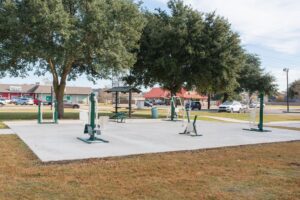
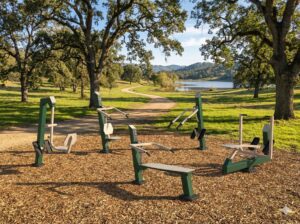
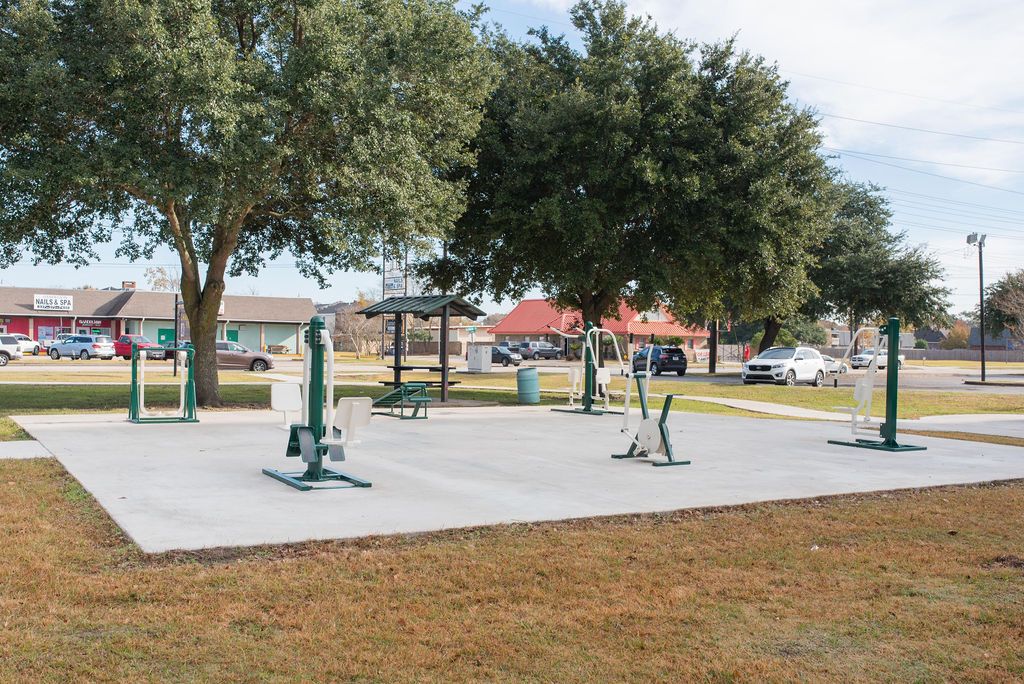
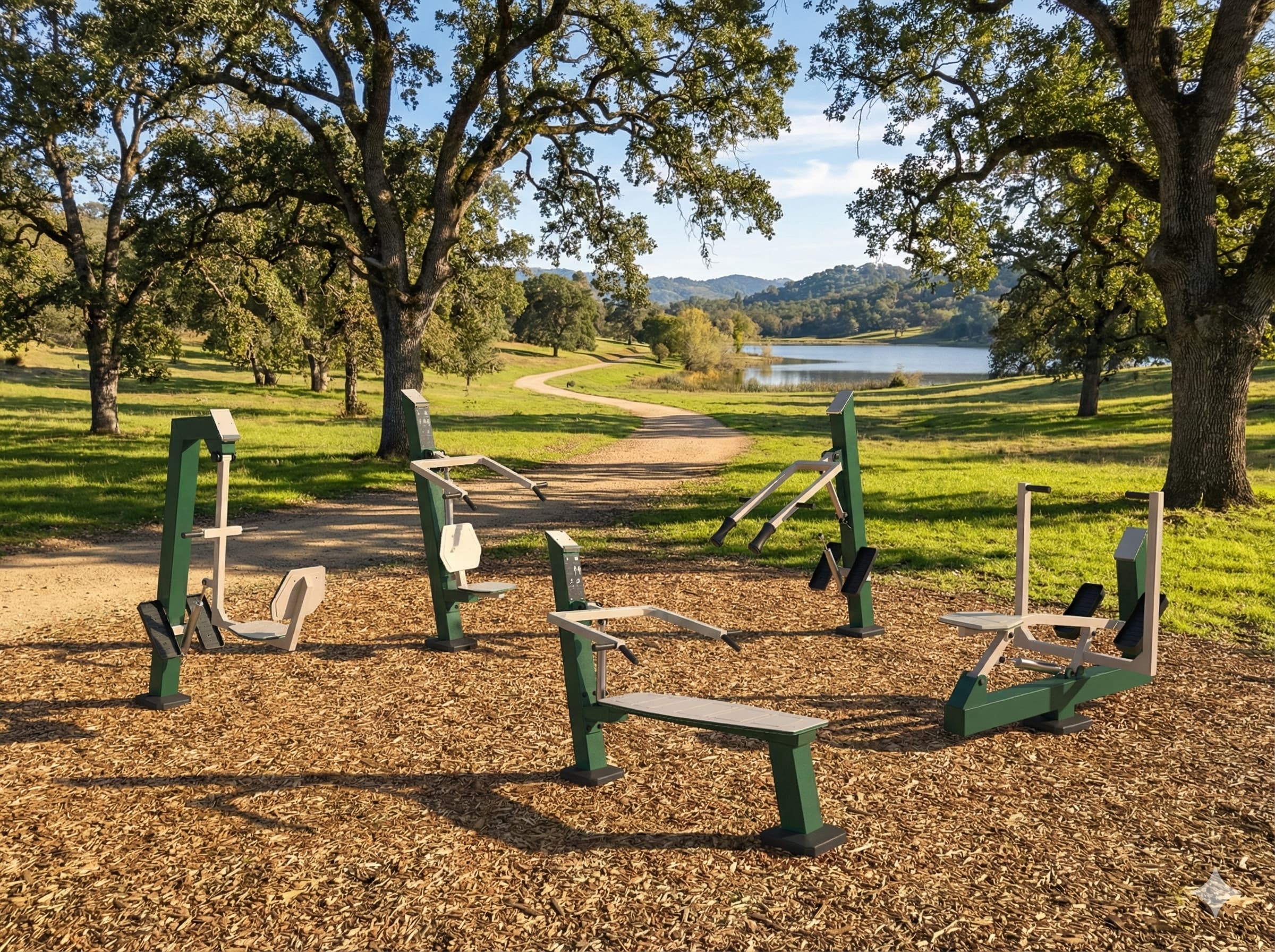
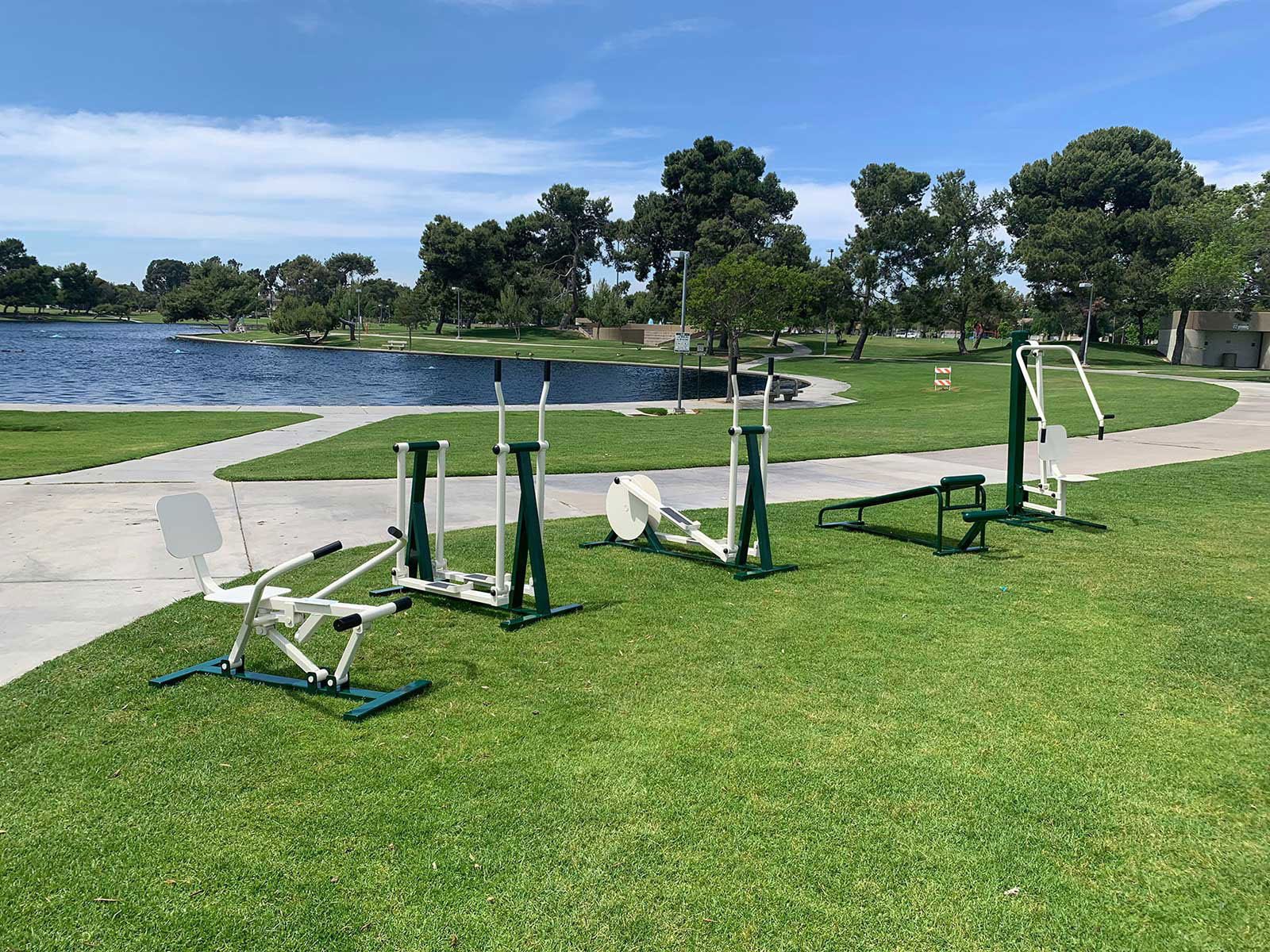
An outdoor fitness park is a cluster of stationary exercise equipment installed in public open space for unsupervised adult use. Typical configurations range from three to eight stations and include pull-up bars, dip stations, step-ups, leg presses, balance trainers, and accessible multi-gym units.
Unlike playgrounds, outdoor fitness parks are designed for users 13 and older. Unlike commercial gyms, they are free to access and operate without staff, membership, or monthly fees.
True institutional outdoor fitness parks use bodyweight or gravity resistance rather than cables, pulleys, or free weights. Equipment is welded rather than bolted, built from 11-gauge steel, and engineered to withstand vandalism and weather. Safety is governed by ASTM F3101, the voluntary standard that specifies structural integrity, entrapment, and impact-attenuation requirements for stationary outdoor fitness equipment.
Physical Health Benefits (Backed by Peer-Reviewed Research)
Meeting CDC and WHO Activity Guidelines
The CDC and WHO both recommend that adults accumulate at least 150 minutes of moderate-intensity aerobic activity per week, plus muscle-strengthening activities on two or more days.
Outdoor fitness parks remove the three most common barriers to meeting this target: cost, distance, and scheduling. When equipment sits in a neighborhood park rather than behind a membership desk, utilization follows.
The RAND Corporation Fitness Zone Evidence
The strongest real-world evidence on outdoor fitness park effectiveness comes from the RAND Corporation’s Family Fitness Zones study, a natural experiment conducted across twelve Los Angeles parks. After installation, researchers documented an odds ratio of 1.58 for higher physical activity levels within the immediate fitness zone and an odds ratio of 1.41 for higher activity across the park as a whole.
Translated: adding outdoor fitness equipment raised the odds that a park visitor engaged in measurable physical activity by roughly 40 to 60 percent, both in and around the installation.
RAND also calculated cost-effectiveness. The installation delivered an estimated 10.5 cents per additional MET (metabolic equivalent) generated, placing outdoor fitness parks among the most efficient physical-activity interventions ever measured in the public-health literature.
A follow-up CDC Preventing Chronic Disease report replicated the finding: installation of a fitness zone in a community park was associated with increased physical activity among park users.
Older Adults and Moderate-to-Vigorous Activity
A PLOS One study by Chow and Choi (2018) directly measured whether outdoor fitness equipment use by older adults qualifies as moderate-to-vigorous physical activity (MVPA). The answer was yes: heart-rate and accelerometer data confirmed that older adults using stationary outdoor fitness equipment reached MVPA thresholds during typical sessions.
This matters because MVPA is the activity category most strongly linked to cardiovascular, metabolic, and cognitive health outcomes in the 65-plus population.
Falls Prevention
Falls are the leading cause of injury and injury-related death among adults aged 65 and older. A 2023 Frontiers in Public Health systematic review found that well-designed exercise interventions reduce the rate of falls in community-dwelling older adults by approximately 25 percent, with balance-focused programs showing reductions up to 39 percent.
Outdoor fitness parks designed with balance-training stations (step-ups, parallel bars, balance beams) map directly onto this evidence base. For senior living operators and municipal recreation directors serving aging populations, this is a quantifiable safety and liability argument, and the right exercise equipment for seniors matters.
Chronic Disease Reduction
The CDC summarizes decades of evidence linking regular physical activity to reduced risk of coronary heart disease, stroke, type 2 diabetes, several cancers (breast, colon, endometrial, bladder, esophagus, kidney, lung, stomach), obesity, hypertension, and osteoporosis.
The Lancet analysis cited earlier attributed the bulk of the projected 300 billion dollar inactivity cost to just five outcomes: coronary heart disease, stroke, type 2 diabetes, breast cancer, and colon cancer. Every additional minute of moderate activity generated by a community installation is a marginal reduction in that cost curve.
Mental Health and Cognitive Benefits
Green Exercise and Mental Well-Being
A 2019 systematic review in the International Journal of Environmental Research and Public Health examined green exercise (physical activity performed in natural outdoor environments) and its effects on psychological well-being.
The review found consistent associations between green exercise and lower anxiety, tension, anger, depression, and fatigue. Self-esteem and mood improved measurably compared to sedentary controls.
A more recent 2025 systematic review and meta-analysis in Frontiers in Public Health refined these findings for urban settings. The strongest mental-health effects came from short-duration interventions (under 12 weeks), high frequency (three or more sessions per week), moderate intensity, and sessions of 20 minutes or less.
That intervention profile maps almost exactly to how people use an outdoor fitness park on a walk through their neighborhood.
One honest caveat for grant writers: the evidence that green exercise produces better mental-health outcomes than indoor exercise is mixed. The stronger claim is that green exercise is substantially better than sedentary behavior, and that outdoor fitness parks reach populations who would not otherwise exercise at all. That is the defensible framing.
Cognitive Function and Dementia Risk
Physical activity is one of the WHO’s twelve modifiable dementia risk factors. Regular moderate activity is associated with reduced rates of cognitive decline, lower incidence of Alzheimer’s disease, and better working memory in older adults. For senior living communities and municipalities serving aging populations, outdoor fitness parks are a low-cost way to extend residents’ functional independence.
Community and Social Benefits
Social Cohesion
A systematic review published in BMC Public Health synthesized qualitative and quantitative evidence on outdoor gyms in public open spaces. Five themes emerged consistently: health, social connectedness, affordability, support, and design.
The social-connectedness finding is particularly relevant for HOA boards and parks departments justifying investment on community-building grounds. These dynamics are explored in our article on how outdoor workouts can improve community health.
Outdoor fitness parks function as what sociologists call third places, neutral ground where residents interact across age, income, and background lines.
Equity and Access
The NRPA 2023 Health Benefits of Parks report documents that proximity to parks is directly correlated with physical activity levels. Communities within walking distance of parks show measurably higher activity rates than those without.
Outdoor fitness parks amplify this effect by adding strength and balance options to what would otherwise be walking-only infrastructure. For low-income neighborhoods where commercial gym memberships are out of reach, a free outdoor installation is often the only strength-training option available.
Increased Park Visitation
Multiple natural experiments documented in the RAND Los Angeles parks research show that installation of outdoor fitness equipment raises overall park visitation, not just fitness-zone usage. New users report visiting parks specifically because of the equipment.
Parks and rec directors can cite this when arguing that outdoor fitness parks deliver a flywheel effect: more visitors, more activity, stronger community presence.
Who Outdoor Fitness Parks Serve Best
Outdoor fitness parks work across six primary institutional settings, each with a distinct benefit profile:
- Parks and recreation: community wellness, park revitalization, equity of access. See our parks and recreation page.
- Senior living communities: falls prevention, cognitive function, resident retention. See our senior living equipment page.
- Schools: PE capacity, recess physical activity, student wellness. See our schools page.
- HOAs and residential communities: amenity value, resident retention, health outcomes.
- Military bases: durability, high-volume use, unit readiness.
- Correctional facilities: rehabilitation outcomes, reduced incidents, bodyweight-only safety. TriActive USA is the #1 correctional fitness equipment manufacturer in the United States with hundreds of installations.
Economic and Cost-Effectiveness Benefits
The Cost of Inactivity
Start with the counterfactual. The WHO’s first-ever Global Status Report on Physical Activity projected that physical inactivity will cost public healthcare systems 27 billion dollars per year, roughly 300 billion over the 2020 to 2030 decade. Every community intervention that shifts sedentary residents toward the 150-minute weekly threshold reduces that cost curve proportionally.
NRPA Economic Impact
The NRPA 2023 Economic Impact Report documented that local park and recreation agencies generated more than 201 billion dollars in US economic activity in 2021, supporting nearly 1.1 million jobs. Parks are not a discretionary line item. They are economic infrastructure.
The 10.5 Cents Per MET Figure
Return to the RAND Family Fitness Zones cost-effectiveness number: 10.5 cents per MET increase. For context, most public health interventions targeting physical activity cost several dollars per MET. Outdoor fitness parks beat pedestrian infrastructure, trail renovations, and most school-based PE programs on this measure. If your grant application needs one single figure to prove cost-effectiveness, this is the one.
Lifecycle Cost Math
Institutional-grade equipment amortizes well. A TriActive outdoor fitness park installation built from 11-gauge welded steel with 1,000 hours of salt-spray resistance testing and a 10-year structural warranty will serve hundreds of users per year over a decade or longer. Divide the installed cost by total user-sessions across that lifespan and the per-use cost typically falls below one dollar. No commercial gym, municipal program, or health intervention competes on that math.
Ready to build a project budget that holds up to scrutiny? Request a quote and our team will help you model cost per user over the equipment’s warranty period.
Using This Evidence in Grant Applications
The evidence above is designed to move directly into grant narratives. Three sources are particularly useful:
Land and Water Conservation Fund (LWCF). State-administered LWCF grants cover up to 50 percent of eligible outdoor recreation project costs. Outdoor fitness parks qualify because they deliver public outdoor recreation and the use restriction (perpetual public outdoor recreation use) aligns with institutional outdoor fitness equipment. Pair your application with ADA-accessible surfacing and compliant equipment choices to strengthen your scoring. Our ADA-compliant outdoor fitness equipment guide covers the relevant standards.
CDC Active People, Healthy Nation. The CDC initiative aims to help 27 million Americans become more physically active by 2027, and grants and technical assistance support community-level interventions. Cite the RAND 10.5 cents per MET figure and the CDC’s own Preventing Chronic Disease article on fitness-zone installations.
State park grants, HRSA community health grants, and private foundations. Each has its own narrative requirements, but the peer-reviewed physical, mental, and community benefits in the sections above are the universal building blocks. For a deeper dive on funding sources, see our grants for fitness equipment guide.
One practical recommendation: link directly to the CDC, WHO, NRPA, RAND, and peer-reviewed articles cited here from within your grant narrative. Reviewers who click through land on credible primary sources, which strengthens the narrative without requiring you to re-host or paraphrase the data.
Frequently Asked Questions
Do Outdoor Fitness Parks Actually Increase Physical Activity?
Yes. The RAND Corporation’s Family Fitness Zones natural experiment documented an odds ratio of 1.58 for higher physical activity levels within the immediate fitness zone and 1.41 across the park as a whole after installation. A CDC Preventing Chronic Disease study replicated the finding. Installation is associated with higher activity both at the equipment and park-wide.
Are Outdoor Fitness Parks Safe for Seniors?
When designed with accessible equipment, compliant surfacing, and balance stations, yes. A 2018 PLOS One study confirmed that older adults using outdoor fitness equipment reach moderate-to-vigorous activity levels.
Systematic reviews show exercise interventions reduce falls by approximately 25 percent in community-dwelling older adults. Senior-friendly installations should follow ADA guidelines and ASTM F3101 safety standards.
How Much Do Outdoor Fitness Parks Cost?
Installed cost varies by station count, surfacing, and site preparation. TriActive institutional-grade multi-station installations typically range from a few thousand dollars for individual stations to the mid five figures for full modular systems. When amortized over a 10-year structural warranty and hundreds of annual users, cost per user-session typically falls below one dollar.
What Grants Can Fund Outdoor Fitness Equipment?
Land and Water Conservation Fund (LWCF) state-administered grants cover up to 50 percent of eligible costs. CDC Active People Healthy Nation grants support community physical-activity interventions. HRSA funds community health projects. Many state park, municipal, and private foundation grants also apply. ADA compliance and public access requirements are typically standard eligibility conditions.
What Is the Lifespan of Outdoor Fitness Equipment?
Institutional-grade equipment built from 11-gauge welded steel with proper powder-coat finishing is engineered for 10 to 25 years of continuous outdoor use. TriActive USA equipment carries a 10-year structural warranty, among the longest in the industry, and is salt-spray tested to 1,000 hours for corrosion resistance.
Conclusion
The benefits of outdoor fitness parks are documented, quantifiable, and cost-effective: roughly 40 to 60 percent higher physical activity in installed zones, 10.5 cents per MET cost-effectiveness, measurable mental-health and falls-prevention outcomes, and social-cohesion impact backed by peer-reviewed systematic reviews. Against the backdrop of a 300 billion dollar global inactivity cost, the case for investment is straightforward.
TriActive USA manufactures 100 percent American-made outdoor fitness equipment built from 11-gauge welded steel with a 10-year structural warranty and hundreds of installations across parks, senior living communities, schools, military bases, and correctional facilities. If you are planning a project, writing a grant application, or building a budget request, contact our team and we will help you scope the right configuration for your site and audience.